
Why We Still Use Premium Leather
There is an uncomfortable trend across many industries today. Products become more expensive, yet the materials used to make them often become cheaper.
We have all noticed that particular item that we have bought previously, being not quite what it was. Furniture made from thinner timber, clothing from lower-grade fabrics. With manufacturers under pressure to reduce costs, many companies make the decision to reduce quality to maintain margins.
At Casström, we believe in the opposite approach.
When we choose materials for our knives and outdoor gear, our goal is not to find the cheapest option that will do the job. Instead, we aim to source the best materials we can find that are suited to a lifetime of use. It's the same philosophy that leads us to use premium AAA-grade curly birch for many of our knife handles, and it's exactly why we continue to use high-quality vegetable-tanned full-grain leather for our sheaths and accessories.

Built to Last
A knife sheath has a simple job: to protect the knife and allow it to be carried safely. Yet not all sheaths are created equal.
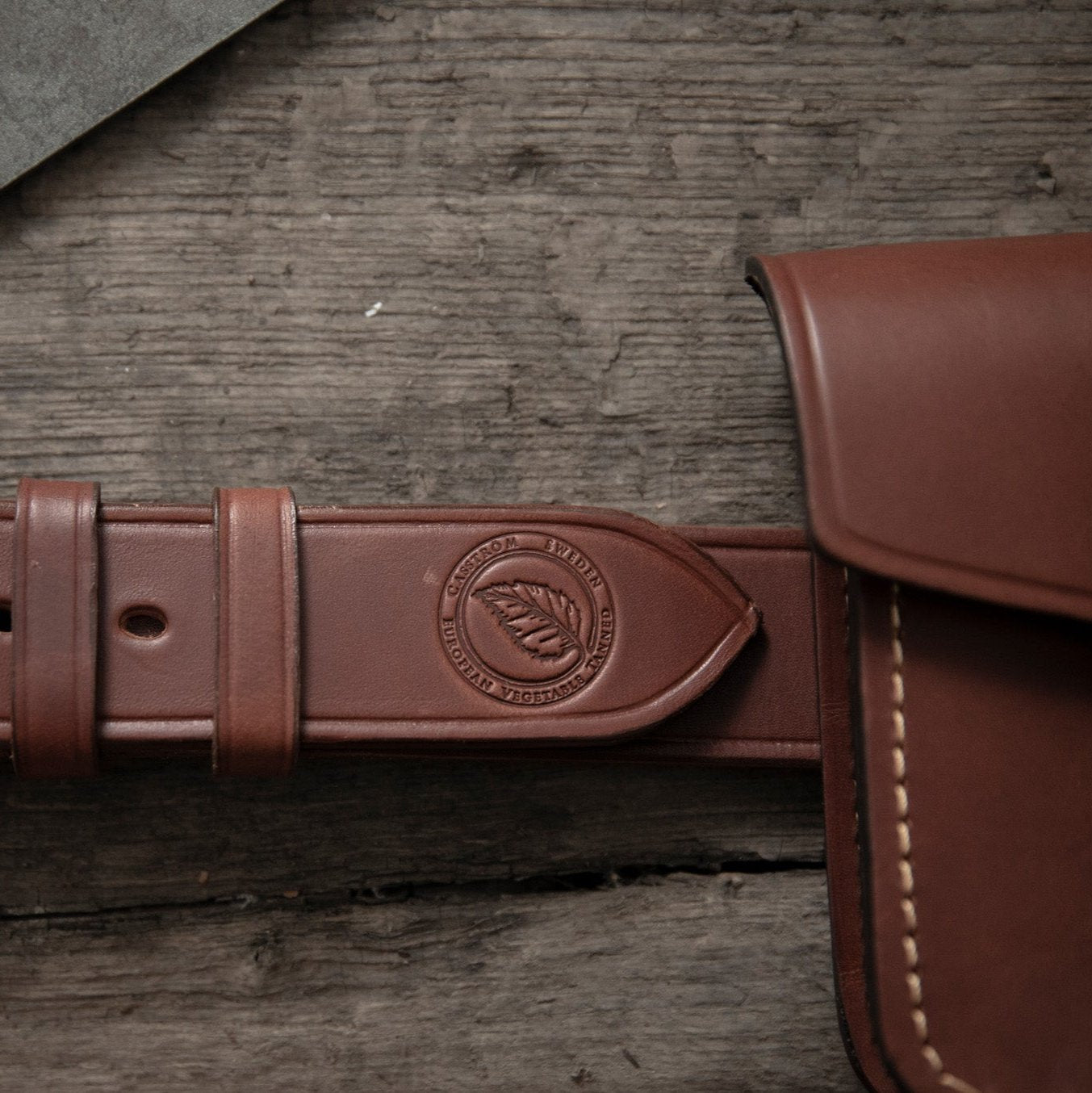
Casström leather sheaths are made from thick 3 mm leather, providing exceptional durability and protection. This extra thickness helps the sheath maintain its shape, resist wear, and continue performing year after year, even when exposed to the demanding conditions of outdoor life.
We design our products with longevity in mind because we believe durability is one of the most important aspects of sustainability. A sheath that remains functional for decades is ultimately a more environmentally responsible choice than one that needs replacing every few years.
The most sustainable product is often the one you never have to replace.
What Is Full-Grain Leather?
One of the most important factors in leather quality is which part of the hide is used.
Many people are unaware that a hide is often split into multiple layers during processing. Some hides can be several millimetres thick, and once the hair has been removed, the hide may be divided into different layers for different applications.
The highest-quality layer is the outermost layer, known as full-grain leather. This is the strongest and most durable part of the hide, retaining the natural grain structure that gives leather its strength and character.
Below this are the split layers. While these can still be used to manufacture leather products, they are generally weaker, less durable, and lack many of the characteristics that make premium leather so desirable.
For our sheaths and leather accessories, we choose full-grain leather because it offers the strength, durability, and longevity that outdoor users expect. Over time it develops a rich patina, telling the story of years spent in forests, mountains, and camps.

It is also worth remembering that leather is a natural by-product of the food industry. The hides used in our leather products originate from cattle raised within the European Union, where animal welfare standards are among the most stringent in the world. By transforming a material that would otherwise have limited value into durable products designed to last for decades, leather represents a practical example of making full use of natural resources rather than allowing them to go to waste.
The Art of Vegetable Tanning
If you've ever looked at a Casström leather product, you've probably seen the words "vegetable tanned". But what does that actually mean?
Vegetable tanning is one of the oldest methods of preserving and transforming animal hides into leather. Instead of using synthetic chemicals, the tanning process relies on naturally occurring tannins extracted from plants and trees.
Natural bark extracts from Quebracho and Mimosa trees are used to slowly transform the leather, creating a material with exceptional strength, elasticity and character.
Unlike mass-produced leather, which prioritises speed and volume, each hide is then treated by hand with multiple applications of natural fats and olive oils. This labour-intensive process gives the leather its distinctive feel, flexibility and durability, while allowing it to develop a rich patina that only improves with years of use in the field.
This artisanal process is carried out by a family-owned company that have been tanning leather for generations, in a region where leatherworking heritage dates to medieval times. The tannery holds a gold award for leatherworking.

Better for People and the Environment
Vegetable tanning also offers environmental advantages compared with many conventional tanning methods.
Because the process relies on natural plant extracts rather than heavy metals, it reduces the use of harsh chemicals during production. This benefits both the environment and the people working with the leather throughout the manufacturing process.
The leather is then treated with natural oils and fats, helping create the flexibility, resilience, and distinctive feel that characterise high-quality outdoor leather goods.
While no manufacturing process is completely without environmental impact, we believe that responsibly sourced vegetable-tanned leather represents a thoughtful balance between performance, durability, tradition, and environmental responsibility.

Choosing Quality Over Shortcuts
Outdoor equipment should not be disposable.
A knife sheath may seem like a simple item, but when it is made from premium full-grain leather, vegetable tanned using traditional methods, and built with sufficient thickness to withstand years of use, it becomes something far more valuable than a simple accessory.
It becomes a product designed to accompany you for decades.
At Casström, we continue to choose premium materials not because they are the cheapest option, but because they are the right option. Whether it is AAA-grade curly birch, cryogenic steel treatment, high-performance knife steels, or thick full-grain vegetable-tanned leather, we believe in “going the extra mile”. Quality materials, and quality manufacturing, remain the foundation of quality products.
And in a world increasingly focused on short-term solutions, we think that is a philosophy worth holding on to.
0 comments